
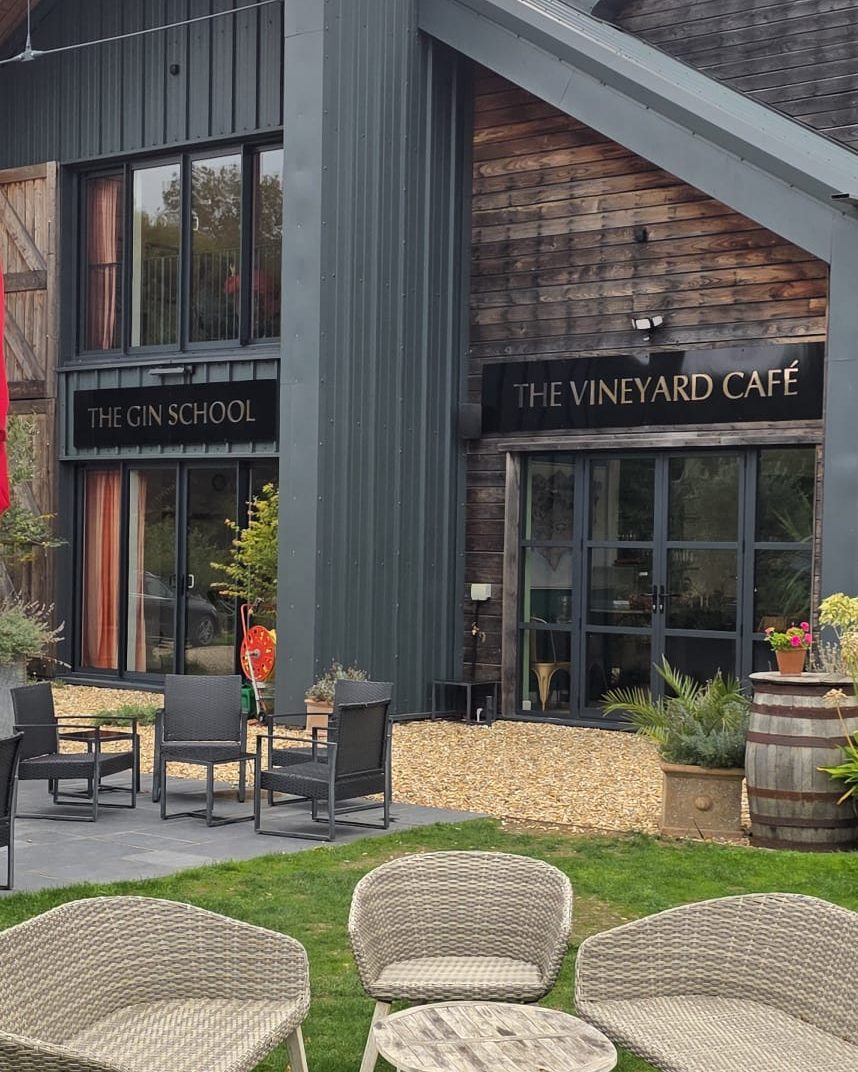


A Vineyard Café Game Changer: Ashling Park Turns Up The Heat With Regale and Panasonic
When Ashling Park Estate introduced its Vineyard Café, the aim was to create a relaxed and accessible way for more people to discover everything the West Sussex destination had to offer. As the café grew in popularity, demand for a fast, quality hot-food offer increased. The installation of a Panasonic NE-SCV3 accelerated cooking oven from Regale has helped the café respond – improving speed, extending its hot-food offer and enabling a small team to handle busy service periods without compromising on quality.
Set amongst the vines at West Ashling, near Chichester, Ashling Park Estate combines an English vineyard with dining, accommodation and visitor experiences. Its wider offer includes vineyard tours and tastings, a restaurant, luxury lodges, gin-making and cocktail-making experiences, while the estate’s food philosophy places an emphasis on locally sourced ingredients.
The Vineyard Café is a more recent addition. Open seven days a week and positioned on the edge of the vines, it offers a relaxed alternative to the estate’s restaurant, with indoor seating and a terrace overlooking the vineyard. Its menu includes a wide selection of cakes, charcuterie and local cheeses, soup, sausage rolls and quiches alongside barista coffee, teas and Ashling Park wines.
For Ashling Park’s Gail Gardner, however, its purpose goes beyond simply providing another place to eat and drink.
For around four years, the estate had operated its restaurant without a café. Gail recognised that, despite everything available at Ashling Park, some local people had never ventured through its gates.
“The idea behind the coffee shop was to make the estate feel more accessible,” she explains.
“People could come down for a coffee, discover what’s here and then perhaps come back with their family for a meal or one of the other experiences.
“It has really worked – in fact, the café has turned into a bit of a beast! There are days when the restaurant can be quieter than the café because it is drawing so many people down to the estate.”
The café began operating in September/October 2025, with demand really starting to build from spring 2026. During the week it has developed a following among local regulars, while weekends bring a different audience, including visitors taking part in Ashling Park’s vineyard tours and tastings.
Those tours can create their own service peaks. Groups of up to 24 people can emerge at the same time, with some choosing the restaurant and others wanting to remain around the café and vineyard terrace.
“While they’re here, we want them to stay and enjoy the estate,” says Gail. “The café offering therefore needs to be relatively simple because we have the restaurant for people wanting something more elaborate – but customers also expect café-style food to be served quickly.”
When popularity creates a new challenge
Success presented Ashling Park with an operational challenge.
Coffee and cakes alone were not enough and customers increasingly wanted savoury and hot-food options. Initially, the café team prepared fresh paninis using a conventional panini press, while products including quiches and sausage rolls were offered cold.
Neither solution proved ideal.
Preparing paninis individually was labour intensive and took a member of staff away from the main café area. As demand increased, Ashling Park eventually became too busy to continue offering them in this way.
“We were making the paninis to order and using the press, but it was taking too long,” explains Gail. “We would have needed another member of staff in a different room preparing them.
“The café was drawing more customers in, so primarily we needed a way of serving the food people wanted without increasing staffing costs.”
Customer expectations were another factor. Feedback showed that visitors wanted items such as sausage rolls and quiches served warm, while waiting times for hot food were also beginning to generate negative comments – something Gail was conscious could affect perceptions of the wider Ashling Park experience.
The challenge was therefore clear: increase the speed and breadth of the café’s hot-food offer while maintaining the quality associated with the rest of the estate – and do so without significantly increasing labour.
Finding the right accelerated cooking solution
Ashling Park researched several accelerated cooking options before selecting the Panasonic NE-SCV3 supplied by Regale.
The compact speed convection oven combines microwave, convection, and grill technologies and is designed for applications such as cooking, toasting, baking, grilling, and reheating. Its Twin Inverter technology promotes even cooking, while the built-in catalytic converter allows ventless operation. A compact 474 mm-wide footprint and stackable configuration also make it well-suited to operations where space is at a premium.
For Ashling Park, one of the practical advantages is that the SCV3 can sit within the café itself.
“People are used to seeing their server preparing food while they wait now,” Gail explains. “The SCV3 can be in the same room, so the team can take an order and quickly put a panini or another product into the oven rather than having somebody disappear elsewhere to prepare it.”
That is particularly valuable given the café’s lean staffing model. Around four team members rotate across the operation, but on a typical weekday the café can operate with just one member of staff, increasing to two or three at weekends.
Bringing hot food back to the menu
The impact has extended beyond simply cooking existing products more quickly.
Ashling Park now uses the SCV3 across much of its savoury café offer, including paninis, sausage rolls and quiches, with soup prepared separately.
Crucially, it has allowed products previously offered cold to be served hot without creating the operational problems the café had experienced before.
Quality was particularly important with quiche. The estate’s head chef was reluctant to reheat it using previous methods because achieving the required core temperature risked overcooking or burning the product.
With the Panasonic, Gail says the team has now found the right programme to bring the quiche to the required serving temperature while maintaining its quality.
That consistency is supported by the SCV3’s programmable touchscreen. The oven can accommodate up to 999 recipe settings, with USB and LAN connectivity allowing menus to be updated, while custom food images can be added to simplify selection for operators.
For a café predominantly operated by a younger team, the simplicity has been another benefit. Following training from Regale, staff have quickly become confident with the oven and are using its pre-programmed functionality to support consistency.
“I don’t know how we would have got through the month without it”
Just weeks after installation, the difference during busy periods was already clear. Asked whether the SCV3 had helped Ashling Park improve throughput and customer waiting times, Gail’s response was unequivocal: “One hundred per cent. This last month that we’ve had one, I don’t know how we could have got through the month without it, to be honest.”
There has also been a tangible change in customer feedback. One customer who had previously contacted Ashling Park to complain about waiting times and the temperature of food subsequently returned following the changes and wrote again – this time to say how much she had enjoyed the experience.
For Gail, that matters because the Vineyard Café is effectively an introduction to the wider Ashling Park brand.
A customer might initially visit for coffee and something to eat, but once through the gates they discover an estate encompassing award-winning wines, vineyard tours, restaurant dining, gin-making experiences and luxury accommodation.
Maintaining the same quality standards at that first, more informal point of contact is therefore important.
“Our restaurant is à la carte and everything we do here is special, so that quality had to carry through into the coffee shop as well,” she says.
Specialist support from Regale
The relationship with Regale extended beyond supplying the oven, with the team providing training to help Ashling Park get the SCV3 operational and its staff comfortable using the programmed settings.
That specialist approach reflects Regale’s focus on matching equipment to an operator’s menu and volume rather than simply supplying an oven. The company works closely with its manufacturing partners to provide application and product advice for commercial operators.
It is an approach Gail is happy to endorse. Asked whether she would recommend both the Panasonic SCV3 and Regale to other café operators, her answer was an immediate “absolutely”.
And, having experienced the difference the oven has made to a café whose popularity exceeded the estate’s original expectations, she has an even simpler description for the investment:
“It has been a game changer.”
Panasonic NE-SCV3 at a glance
Designed for fast-paced foodservice operations, the Panasonic NE-SCV3 combines 1050W microwave output, 1465W convection and a 1915W grill, with a convection temperature range of 180–280°C.
Its key features include a compact 474mm-wide footprint; stackable design; Twin Inverter technology for even cooking; built-in catalytic converter for ventless operation; touchscreen control; up to 999 cooking programmes; USB and LAN connectivity for menu updates; and an easy-to-clean cavity.
The oven is designed to cook, toast, bake, grill and reheat products including toasted sandwiches, pastries and pizzas, producing a crisp, browned finish while supporting faster service.
